 |
| "NERRRRRDDDDDD!" |
Monday, March 7, 2016

Buzzword University
 |
| Learn to be Innovative! Be an Entrepeneur! |
Bachelor of Innovation
LOL. I came across this bachelor's degree while reading the campus newspaper. What a bullshit major! An illegitimate child of trendy buzzwords and 'synergized' corporate mysticism. 'Innovation' is even trademarked. LULLERZ.
"UCCS is the first school to offer a bachelor’s degree with a core on innovation. Innovation, the transformation of ideas into impact, is a process that can be taught. It is a process that involves not just creativity (that is invention), but also the skills to work with others to move that idea forward and implement it for business and/or social impact."
- http://innovation.uccs.edu/
There's a reason no such study or school of learning existed. Because it's not any real specific thing. It's just a blanket description for the outcome of any number of possible distinct, varied, and non-communal work derived from other real branches of humanities or science, etc.
You might as well open up a school for Outstanding Achievement in the Field of Excellence.
"Webster's Dictionary defines 'excellence' as the quality or condition of being excellent."
- Smokin' Joe Frazier
Frazier's explanation is just as meaningful as the degree is.
Other Ideas
Why stop at Innovation? There are plenty of valuable corporate values that our promising young generation needs to educate themselves about! We could open a revolutionary new system of higher education!
Let's offer these best in class degrees of study!
Bachelor of Arts:
- Thinking Outside the Box
- Bringing Ideas to the Table
- Moving the Organization Forward
- Using Integrated Approach
- Fast Track Growth
Reading
Sunday, March 6th, 2016.
Being a kid
Having the time and freedom to curl up and read feels so nice. I used to sit upside down on the sofa with the Boxcar Children series when I was eight years old, and read all day on Sundays like this.
Nemesis
Because it rhymes
(with DOOK! DOOK! DOOK!) ...
Charm
You can find a lot of interesting bookmarks inside the books people donate to Goodwill.
I commonly find the receipt for the book tucked inside the back cover. I've also seen plane tickets, itineraries, and other documents which reveal the name of the person who donated the book.
After I examine these curios I put them back in the book and leave their discovery for the next reader to chance upon. I think it adds charm to the secondhand experience!
 |
| Ute Valley Park. Colorado Springs, CO. |
Being a kid
Having the time and freedom to curl up and read feels so nice. I used to sit upside down on the sofa with the Boxcar Children series when I was eight years old, and read all day on Sundays like this.
 |
| Whether it's on a park bench... |
 |
| or in a nook |
... I can't put down a good good book!
Nemesis
Because it rhymes
(with DOOK! DOOK! DOOK!) ...
 |
| The BAD BAD BOOK! |
 |
| The Babadook (2014 Movie) |
Charm
You can find a lot of interesting bookmarks inside the books people donate to Goodwill.
 |
| Ultrasound photo. Aristotle's Ethics |
I commonly find the receipt for the book tucked inside the back cover. I've also seen plane tickets, itineraries, and other documents which reveal the name of the person who donated the book.
After I examine these curios I put them back in the book and leave their discovery for the next reader to chance upon. I think it adds charm to the secondhand experience!
Thursday, March 3, 2016
Pale Fire on Index Cards
Done!
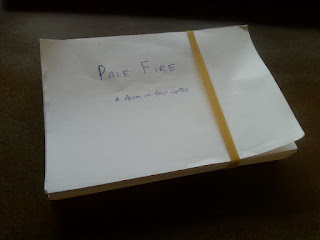
Here's the photo album of all eighty note cards: Pale Fire.
Update: Google photos organizes the pictures out of order, so I manually sorted them onto this page
Some remarks about my edition of the poem:
Unnumbered. I feel like Nabokov would have numbered the cards 1 to 80, just to the right of the canto number... but because it wasn't explicitly stated in the description found in the Forward, I didn't number the cards.
Partially dated. I did not date every card, because the date of writing is not available for each card. So where a date was available, I put a date on the card and did not speculate about the dates between. I used Jerry Friedman's timeline on good faith, without checking his references. Notes relevant to the writing of the poem I've highlighted from an excerpt of Friedman's timeline.
Line shift. From Canto Two to the end of the poem, the verses are written on the proper line of each card, and the structure is accurate. But the first canto I've reproduced with a mistake with the structure of the lines starting from card one. Line 3: "Retake the falling snow..." should be written on the fourteenth line of card one, not at the first line of card two. This mistake does not carry over to subsequent cantos; only the lines in Canto One are out of place by one line.
Italics. I chose to write words in italics ... in italics. I know you're supposed to underline instead of using slanty font when it's handwritten and stuff, but I hate how that looks and disliked doing it from the time they taught us in fifth grade. Granted, it may be harder to discern whether the word is italicized or not, when hand-written, but I think you can figure it out without too much uncertainty.
Any last words, John Shade?

A popular theory is that the 999 lines of Pale Fire are incomplete and that the final line the author John Shade would have written is a refrain of the first line: "I was the shadow of the waxwing slain". Note that the unwritten line 1000 would fall exactly on the last line of the final card! Coincidence? I think not!

Writing out Pale Fire onto note cards payed off. See, there is structure within the poem according to the fourteen line organization of the cards! You can find it in each card, in some way shape or form.

Update: Google photos organizes the pictures out of order, so I manually sorted them onto this page
Some remarks about my edition of the poem:
Unnumbered. I feel like Nabokov would have numbered the cards 1 to 80, just to the right of the canto number... but because it wasn't explicitly stated in the description found in the Forward, I didn't number the cards.
Partially dated. I did not date every card, because the date of writing is not available for each card. So where a date was available, I put a date on the card and did not speculate about the dates between. I used Jerry Friedman's timeline on good faith, without checking his references. Notes relevant to the writing of the poem I've highlighted from an excerpt of Friedman's timeline.
Line shift. From Canto Two to the end of the poem, the verses are written on the proper line of each card, and the structure is accurate. But the first canto I've reproduced with a mistake with the structure of the lines starting from card one. Line 3: "Retake the falling snow..." should be written on the fourteenth line of card one, not at the first line of card two. This mistake does not carry over to subsequent cantos; only the lines in Canto One are out of place by one line.
Italics. I chose to write words in italics ... in italics. I know you're supposed to underline instead of using slanty font when it's handwritten and stuff, but I hate how that looks and disliked doing it from the time they taught us in fifth grade. Granted, it may be harder to discern whether the word is italicized or not, when hand-written, but I think you can figure it out without too much uncertainty.
Any last words, John Shade?

A popular theory is that the 999 lines of Pale Fire are incomplete and that the final line the author John Shade would have written is a refrain of the first line: "I was the shadow of the waxwing slain". Note that the unwritten line 1000 would fall exactly on the last line of the final card! Coincidence? I think not!

Writing out Pale Fire onto note cards payed off. See, there is structure within the poem according to the fourteen line organization of the cards! You can find it in each card, in some way shape or form.
Wednesday, March 2, 2016
I have this many years: 29
Tradition:
Following my personal tradition of Ice Cream cake on my birthday, I bought a Lil' Love at midnight and ate as much as I could before bed. Woo hooo!

Then in the morning, I drank the remaining soup out of its plastic bag. ^_^
Burs:
Every celebration needs a swaggin' song.
Ice Cream Cake:
Why every birthday should have Ice Cream cake. 'Cause Lenny got to!
Following my personal tradition of Ice Cream cake on my birthday, I bought a Lil' Love at midnight and ate as much as I could before bed. Woo hooo!

Then in the morning, I drank the remaining soup out of its plastic bag. ^_^
Burs:
Every celebration needs a swaggin' song.
"If u don't sing, u don't get no bursday cake" - Gil (gmcfosho).
Ice Cream Cake:
Why every birthday should have Ice Cream cake. 'Cause Lenny got to!
"But-but-but, you're gonna kill us all!" - Ned Flanders
Badly misunderstood, but seldom wrong!
I came across this comment (which I find hilarious) in the MIT Quantum Physics II lecture series:
In my opinion, 'badly misunderstood, but seldom your misunderstanding leads to a serious mistake' describes all physics education in a nutshell!
In my opinion, 'badly misunderstood, but seldom your misunderstanding leads to a serious mistake' describes all physics education in a nutshell!
Tuesday, March 1, 2016
False Logic
Nabokov writes this silly logical fallacy in Pale Fire:
Here Nabokov is intentionally misusing the syllogism of the form:
Take 'P' as mortal, 'S' as I the narrator, and 'M' as other men. The logical reasoning then goes like this:
Or if you want to separate the truth of the premises from that of the validity of the logical deduction, you could say the syllogism is valid but its conclusion is false, since its major premise is false.
Satire
I believe Nabokov is using this false syllogism to make fun of the hubris of man to attempt at the power of immortality. I wouldn't be surprised to hear false syllogisms like this intentionally used in politics. And sure enough, a book has been written about using these deceptive logic tricks in rhetoric to gain political sway.
The Art of Conversery (aka The Art of Being Right) by Arthur Schopenhauer is a satirical how-to treatise written in Germany in 1831 on directing a false, but seemingly plausible argument as an expedient way to deceive the masses, or discredit opponents. wiki. The author was a philosopher who reviled and wanted to expose this unethical practice to stop it. (I think contemporaries read his work with the opposite intention.)
Politics
The twenty-fourth strategy discussed by Schopenhauer is to 'State a False Syllogism' to attack the true statement from which your false conclusion illogically derives.
Applied to Nabokov's example, one would use the false syllogism to discredit the assertion that other men die.
How bout something like:
A syllogism: other men die; but ILogic
Am not another; therefore I'll not die.
Here Nabokov is intentionally misusing the syllogism of the form:
ref: http://www.thelogician.net/2_future_logic/2_chapter_09.htm
Take 'P' as mortal, 'S' as I the narrator, and 'M' as other men. The logical reasoning then goes like this:
All mortals are other men.The first statement (major premise) is clearly the false one. Other men are all mortal, but not all mortals are other men. There is one mortal who is not another; that mortal is myself. Therefore the syllogism is false.
This man, myself, is not other men.
I am immortal.
Or if you want to separate the truth of the premises from that of the validity of the logical deduction, you could say the syllogism is valid but its conclusion is false, since its major premise is false.
/sil'oh-jiz`*m/ Deductive reasoning in which a conclusion is derived from two premises. The conclusion necessarily follows from the premises so that, if these are true, the conclusion must be true, and the syllogism amounts to demonstration. To put it another way, the premises imply the conclusion.
For example, every virtue is laudable; kindness is a virtue; therefore kindness is laudable.
Strangely, a syllogism can still be true if the premises are false. Compare inference rule.
[Relationship between premises?]
(2009-10-28)
The Free On-line Dictionary of Computing, © Denis Howe 2010 http://foldoc.org
Satire
I believe Nabokov is using this false syllogism to make fun of the hubris of man to attempt at the power of immortality. I wouldn't be surprised to hear false syllogisms like this intentionally used in politics. And sure enough, a book has been written about using these deceptive logic tricks in rhetoric to gain political sway.
The Art of Conversery (aka The Art of Being Right) by Arthur Schopenhauer is a satirical how-to treatise written in Germany in 1831 on directing a false, but seemingly plausible argument as an expedient way to deceive the masses, or discredit opponents. wiki. The author was a philosopher who reviled and wanted to expose this unethical practice to stop it. (I think contemporaries read his work with the opposite intention.)
Politics
The twenty-fourth strategy discussed by Schopenhauer is to 'State a False Syllogism' to attack the true statement from which your false conclusion illogically derives.
This trick consists in stating a false syllogism. Your opponent makes a proposition, and by false inference and distortion of his ideas you force from it other propositions which it does not contain and he does not in the least mean; nay, which are absurd or dangerous. It then looks as if his proposition gave rise to others which are inconsistent either with themselves or with some acknowledged truth, and so it appears to be indirectly refuted. This is the diversion, and it is another application of the fallacy non causae ut causae.
Applied to Nabokov's example, one would use the false syllogism to discredit the assertion that other men die.
'Look, you're saying other men die. But I'm not another man... I won't die! That's absurd, of course I will die. So clearly you are wrong to claim that other men die.'This refutation is just as silly and easy to disbelieve as Nabokov's original assertion, but a tangled misdirection causes some confusion as to why exactly the argument is false. Applied to more ambiguous issues, the false conclusion might go undetected!
How bout something like:
'Look, you're saying our belligerent policies are killing our young men who go off to war. But I'm not a soldier... does that mean I won't get killed?!? I could just as easily get killed while driving! So it's ridiculous to suggest that we're putting soldiers in danger!'We have a gut feeling that the fictitious politician, speaking above, is lying to us (beyond the simple fact that he is a politician), but it is less obvious how he is doing it. And if we happen to agree with the insanity he is spouting because we want to believe it, then perhaps we let him spread his conservative views on the radio like say, Rush Limbaugh.
Subscribe to:
Posts (Atom)